Beyond the basic types, a few features and older fittings often come up when homeowners plan new downlights.
Halogen versus LED
Many older homes still have halogen downlights. Halogen fittings produce a lot of heat and use more power than LED fittings for a similar amount of light. LED downlights run much cooler and tend to last longer, which is why many homes have moved to LED. Swapping halogen for LED is usually more than changing a globe. The fitting, the driver or transformer and the hole in the ceiling may all need to suit the new light, so it is a job for an electrician.
If an older downlight flickers, buzzes or smells of burning, switch the light off at the wall switch and call an electrician. If there is smoke or fire, call 000 first.
Dimmable LED
A dimmable LED downlight can be turned down to a lower level of light, which can suit living rooms, dining areas and bedrooms. Not every LED downlight is dimmable, and not every dimmer suits every LED fitting. The fitting, the driver and the dimmer need to work together, or the light may flicker or hum. An electrician can check what is already in place and recommend fittings and a dimmer that suit each other.
Downlights also come in different light colours. Warm white light has a soft, yellowish feel that many people like in living areas and bedrooms. Cool white light looks crisper and brighter, and it is often used in kitchens, laundries and bathrooms. Some fittings let you switch between the two.
Fire rated fittings
Fire rated is a general term for a downlight designed to suit certain ceilings where fire separation matters, such as between some apartments or levels. Not every home needs fire rated fittings, but some ceilings do. An electrician can advise if a fire rated fitting is needed for your ceiling before any work is planned.
Ceiling Lights, Installation and the Next Step
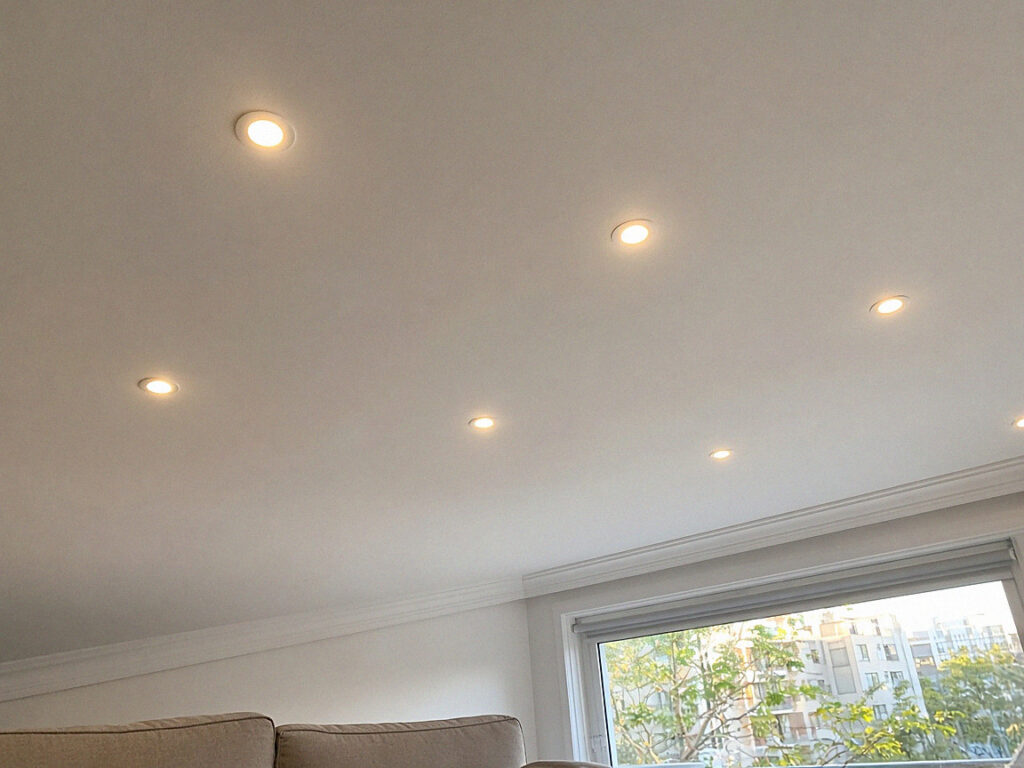
Once you know the main types, the next step is matching them to each room and having them fitted safely.
Which type may suit which room
Downlights are only one kind of ceiling lights, and the right mix depends on how each room is used. As a general idea:
- Living areas often suit recessed or COB fittings, with dimmable LED for flexibility
- Kitchens often suit evenly spaced recessed fittings, with adjustable heads over benches
- Bedrooms often suit warm white dimmable LED fittings
- Bathrooms and laundries often suit fittings chosen for damp areas, in cool white light
- Hallways often suit fixed recessed fittings spaced along the ceiling
For more on choosing light for each room, read how to choose light bulbs for each area of your home. If you are thinking about a wider change to the lighting in your home, read about the benefits of residential lighting upgrades.
Installation is a job for an electrician
Fitting downlights is electrical work. It involves cutting the ceiling, working in the ceiling space, connecting wiring and checking that each fitting suits the ceiling and any insulation. Please do not remove fittings, go into the ceiling space or touch wiring yourself. A qualified electrician can plan the layout, fit the downlights and test them. For what to expect, read our tips for downlight installations. For other work around the home, see our electrical services in Sydney.
Cost
The cost of LED downlights depends on several things:
- The type of fitting, such as recessed, surface mounted, COB or dimmable LED
- The number of downlights and rooms
- If existing halogen fittings or transformers need to be removed
- The ceiling type, access and any insulation
- If dimmers or fire rated fittings are needed
Your electrician will confirm the price for your job. Call us for a free quote.
Frequently Asked Questions
What are the main LED downlight types?
Common LED downlight types include recessed and surface mounted fittings, fixed and adjustable heads, COB downlights and dimmable LED options.
What does fire rated mean for a downlight?
Fire rated is a general term for a fitting chosen to suit certain ceilings. An electrician can advise if a fire rated fitting is needed. The details depend on the ceiling and the fitting.
Are halogen downlights still common?
Many homes now use LED downlights in place of halogen fittings. The right option depends on the room and the existing fitting.
Can I install LED downlights myself?
No. Downlight installation is electrical work. Leave the ceiling and the wiring alone, and ask a qualified electrician to do the job.
Do LED downlight types cost a set amount?
No. The cost depends on the type, the number of fittings, the ceiling and the scope of the job. Ask for a quote after a site check.
Talk to Charlie Sparks About LED Downlight Types
Charlie Sparks is a Condell Park solar and electrical company helping homes in Bankstown, Yagoona, Bass Hill and across greater Sydney. Sydney’s Trusted Solar Installers with Solar Accreditation (SAA) for safe, quality, and on-time solar and electrical solutions. Serving New South Wales residents, businesses, and strata estates for over a decade.
Call us for a free quote.
Call Charlie Sparks on (02) 8310 4077. We are open Monday to Saturday, 7am to 6pm. Closed Sunday. You can also contact Charlie Sparks online.