These three designs describe how the fan moves air. You do not need to know the engineering, but knowing the names helps when you compare options with an electrician.
Axial fans
An axial fan moves air in a straight line, along the same direction as the shaft the blades turn on. Axial fans are common in ceiling mounted and wall mounted exhaust fans, especially where the air only needs to travel a short distance to the outside.
Axial fans are often a simple, compact option for a bathroom, ensuite or laundry with a short path to the outside. They may be less suited to longer duct runs, where the air has further to travel.
Inline fans
An inline fan sits inside the ducting itself, usually in the ceiling space, rather than directly behind the grille in the room. Only a grille is visible in the room, and the fan motor sits further along the duct.
Because the motor is away from the room, some homeowners find inline fans quieter in the room. They can also suit homes where one fan draws air from more than one room, or where the duct needs to run some distance to the outside. Fitting an inline fan involves work in the ceiling space, so it is always a job for an electrician.
Centrifugal fans
A centrifugal fan draws air in and then pushes it out at an angle, using a spinning wheel of blades. This design can push air through longer or more complex duct runs than many axial fans.
Centrifugal fans are often used where a bathroom or kitchen is in the middle of the home and the duct has to travel further to reach the outside. An electrician can advise if this design suits your layout.
Bathrooms, Kitchens and the Next Step
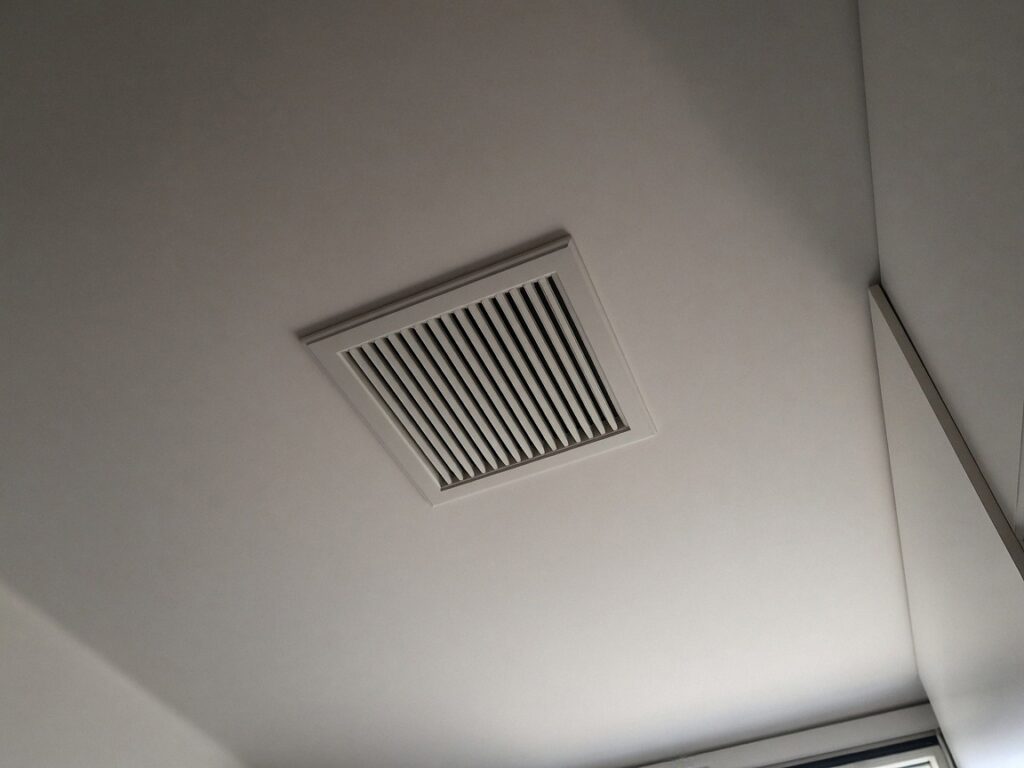
Here is how the main types may suit each room.
Which type may suit a bathroom
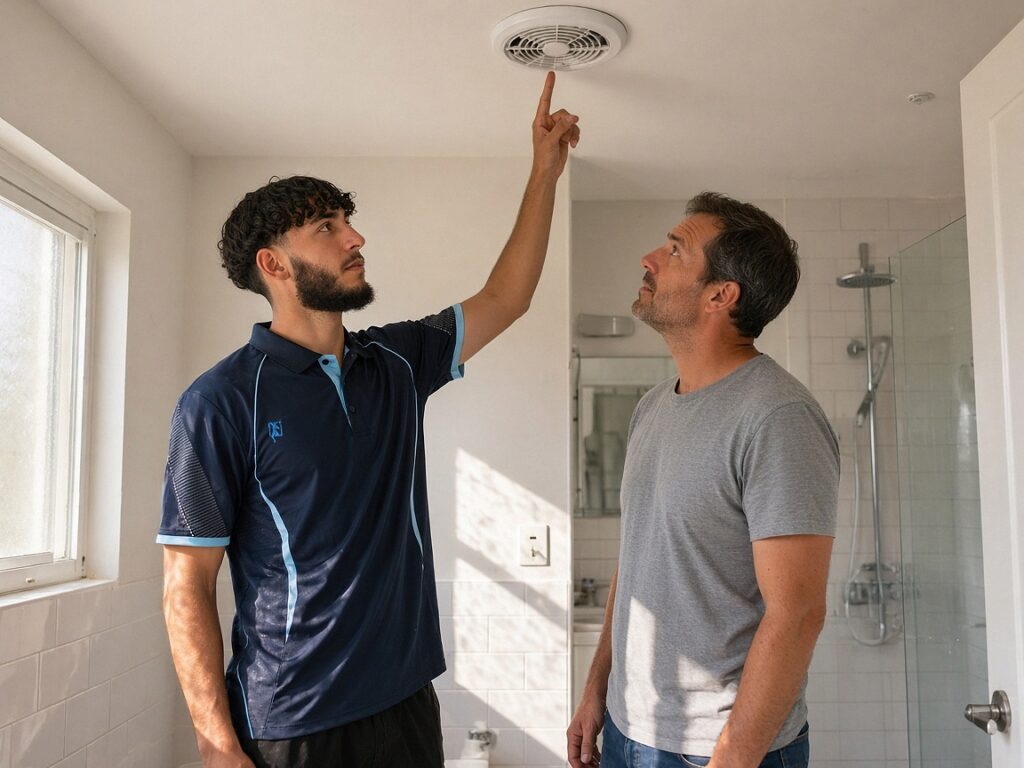
Many bathrooms use a ceiling mounted fan, often an axial design, ducted to the outside. Larger bathrooms, ensuites in the middle of the home, or homes with longer duct runs may suit an inline or centrifugal fan. Some bathrooms combine the fan with a light or a heater in one unit.
The right fan depends on the size of the room, where the duct can run, and how the room is used. For what is involved in fitting one, read our guide to bathroom exhaust fan installation. Fitting or replacing a fan is a job for an electrician.
Kitchen exhaust
A kitchen often uses a rangehood above the cooktop to capture steam, smoke and cooking smells. Some kitchens also have a ceiling mounted or wall mounted exhaust fan for general ventilation. Where the rangehood or fan vents to, and how far the duct runs, can affect which type suits the room.
An exhaust fan is not the same as a cooling ceiling fan. A ceiling fan with large blades moves air around a room to keep you cool, while an exhaust fan removes air from the room. If you are after a cooling fan, read about ceiling fan installation in Sydney.
Cost
The cost of a new or replacement exhaust fan depends on several things:
- The type of fan and where it is mounted
- The room and the layout of your home
- The length and route of the duct run
- Access to the ceiling space or the roof
- If new wiring or a new switch is needed
Your electrician will confirm the price for your job. Call us for a free quote. You can also read about our wider electrical services in Sydney.
Frequently Asked Questions
What are the main types of exhaust fans?
Common types include ceiling mounted, wall mounted, axial, inline and centrifugal fans. The right type depends on the room and the duct run.
What type of exhaust fan suits a bathroom?
A bathroom exhaust fan is often a ceiling mounted or inline unit, depending on the space. An electrician can advise after a site check.
What type of exhaust fan suits a kitchen?
A kitchen may use a dedicated exhaust system, or a ceiling mounted exhaust fan for general ventilation. The right type depends on the layout.
Can I install an exhaust fan myself?
No. Exhaust fan installation is electrical work, and some jobs also involve the ceiling or the roof. Leave it to a qualified electrician. Do not climb into the roof.
Do exhaust fans cost a set amount?
No. The cost depends on the type, the room, the duct run and the scope of the job. Ask for a quote after a site check.
Talk to Charlie Sparks About Types of Exhaust Fans
Charlie Sparks is a Condell Park solar and electrical company helping homes in Bankstown, Yagoona, Bass Hill and across greater Sydney. Sydney’s Trusted Solar Installers with Solar Accreditation (SAA) for safe, quality, and on-time solar and electrical solutions. Serving New South Wales residents, businesses, and strata estates for over a decade.
Call us for a free quote.
Call Charlie Sparks on (02) 8310 4077. We are open Monday to Saturday, 7am to 6pm. Closed Sunday. You can also contact Charlie Sparks online.